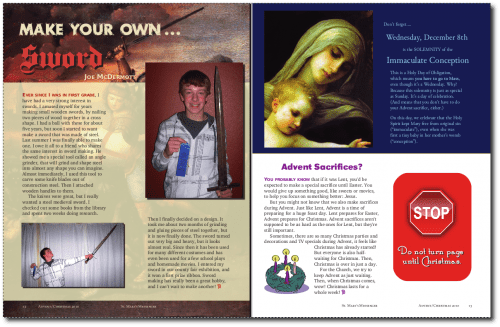
Ever since I was in first grade, I have had a very strong interest in swords. I amused myself for years making small wooden swords by nailing two pieces of wood together in a cross shape. I had a ball with these for about five years, but soon I started to want make a sword that was made of steel. Last summer I was finally able to make one. I owe it all to a friend who shares the same interest of sword making. He showed me a special tool called an angle grinder, that will grind and shape steel into almost any shape you can imagine. Almost immediately, I used this tool to carve some knife blades out of construction steel and then attached wooden handles to them.
The knives were great, but I really wanted a steel medieval sword. I checked out some books from the library and spent two weeks doing research. Then I finally decided on a design. It took me about two months of grinding and gluing pieces of steel together, but it is now finally done. The sword turned out very big and heavy, but it looks almost real. Since then it has been used for many different costumes and has even been used for a few school plays and homemade movies. I entered my sword in our county fair exhibition, and it won a first prize ribbon. Sword making has really been a great hobby, and I can’t wait to make another!
Emilia was helping Nana make Christmas dinner. This dinner wasn’t a
turkey with stuffing. It was sandwiches — a whole table full! Emilia
was in the kitchen in the church basement, making a free Christmas
dinner for homeless people.
First Nana laid rows and rows of bread on the counter. Emilia put
two slices of turkey on each slice of bread. Nana put two slices of
cheese. Emilia squirted mustard. Nana squirted mayonnaise. And
Emilia put another slice of bread on top.
“Please can I do the mustard?” Renzo said.
“You’re only four,” Emilia said.
“You’re only seven!”
“Why don’t you go play with Mark?” Nana said. Renzo stomped away.
They put the sandwiches on a big platter. “I can carry it,” Emilia
said.
“Okay,” Nana said. “Be careful.”
The sandwiches were heavy. Very heavy. Nana went out of the
kitchen, and Emilia followed her. The church hall was packed with
tables and wreaths and strangers.
“Hi, Emilia!” said Father Poppo. He was wide and loud, like Santa
Claus. “You sure you won’t drop that mountain of sandwiches?”
Emilia nodded. The sandwiches were so heavy she couldn’t talk.
She walked with Nana walked towards a table. Emilia imagined
dropping the sandwiches. Cheese and turkey would go
everywhere. Renzo would dance on the squishy pile and soak his
sneakers with mustard.
At the table, a woman sat alone. She stared at her hands. She
didn’t smile or frown. She was like a statue of ice.
Emilia tried to skip her, but Nana nodded at her. Emilia’s hands
started to shake. “Don’t worry, sweetie,” Nana whispered.
But Emilia knew she was about to drop those sandwiches. She ran
over and slammed the platter on the table.
The mountain of sandwiches collapsed.
Sandwiches slid like an avalanche. They tumbled onto the table. One
skittered right onto the woman’s lap. It left a bright trail of
mustard.
Emilia wished she could turn into a sandwich herself, at the bottom
of the pile. She tried to say, “I’m sorry,” but she just squeaked.
But the woman started to laugh. “It’s okay, honey. I’m not going to
eat you. Just what’s left of this sandwich.”
Then Nana laughed. And Emilia laughed too, because otherwise she
would start crying.
Nana said, “I hope you like mustard.”
“I look good in mustard,” the woman said. “Everyone always tells
me.”
Emilia and Nana piled the sandwiches and took them to other
people. Some thanked Emilia. Others didn’t look up. But everyone
got something to eat.
When the platter was empty, they went to the kitchen to make
more. Renzo was waiting. “Nana, can I please, please do the
mustard?”
“Ask Emilia,” Nana said.
“Please?”
Emilia hesitated. Renzo actually waited, and didn’t ask again, so
she said, “Sure.”
“Hooray!” Renzo shouted. They laid out some bread, and Renzo
squeezed the mustard.
SQUIRT! Mustard went everywhere.
“Oh no! I made a mess!” He looked at Emilia to see if she was mad.
But she smiled. “It’s okay. I look good in mustard. And so does
everything else.”
Yesterday was the feast of Corpus Christi, which is Latin for “Body of Christ”. We celebrated the gift of the Eucharist. Although the Eucharist looks like bread and wine, It is really the Body, Blood, Soul and Divinity of Jesus Christ.
Jesus promised He would give us Himself as the bread of life.
I am the living bread which came down from heaven.
If any man eat of this bread, he shall live for ever; and the bread that I will give, is my flesh, for the life of the world.
John 6:51–52 (DRC)
At the Last Supper, He kept this promise.
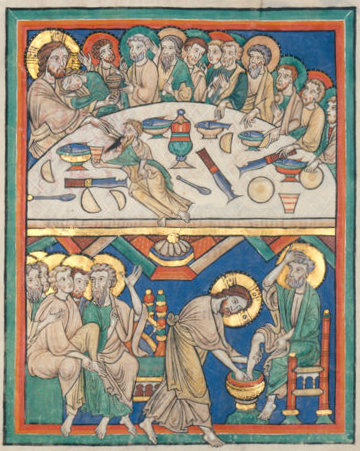
This picture is from an old illuminated manuscript, the Codex Bruchsal. On the top, we see Jesus raising the chalice. He is consecrating the wine, as the priest does today at Mass.
And whilst they were eating, Jesus took bread; and blessing, broke, and gave to them, and said: Take ye. This is my body.
And having taken the chalice, giving thanks, he gave it to them. And they all drank of it.
And he said to them: This is my blood of the new testament, which shall be shed for many.
Mark 14:22–24 (DRC)
On the bottom, we see what happened after the supper: Jesus washed the feet of His disciples.
Then after he had washed their feet, and taken his garments, being set down again, he said to them: Know you what I have done to you?
You call me Master, and Lord; and you say well, for so I am.
If then I being your Lord and Master, have washed your feet; you also ought to wash one another’s feet.
For I have given you an example, that as I have done to you, so you do also.
Amen, amen I say to you: The servant is not greater than his lord; neither is the apostle greater than he that sent him.
If you know these things, you shall be blessed if you do them.
A Man and his son were once going with their Donkey to market. As they were walking along by its side a countryman passed them and said: “You fools, what is a Donkey for but to ride upon?”
So the Man put the Boy on the Donkey and they went on their way. But soon they passed a group of men, one of whom said: “See that lazy youngster, he lets his father walk while he rides.”
So the Man ordered his Boy to get off, and got on himself. But they hadn’t gone far when they passed two women, one of whom said to the other: “Shame on that lazy lout to let his poor little son trudge along.”
Well, the Man didn’t know what to do, but at last he took his Boy up before him on the Donkey. By this time they had come to the town, and the passers-by began to jeer and point at them. The Man stopped and asked what they were scoffing at. The men said: “Aren’t you ashamed of yourself for overloading that poor donkey of yours and your hulking son?”
The Man and Boy got off and tried to think what to do. They thought and they thought, till at last they cut down a pole, tied the donkey’s feet to it, and raised the pole and the donkey to their shoulders. They went along amid the laughter of all who met them till they came to Market Bridge, when the Donkey, getting one of his feet loose, kicked out and caused the Boy to drop his end of the pole. In the struggle the Donkey fell over the bridge, and his fore-feet being tied together he was drowned.
“That will teach you,” said an old man who had followed them:
Magnets are used in many things. Compasses, engines, generators, and even some of your favorite toys use magnets. The whole Earth is surrounded by a gigantic magnetic field with north and south poles!
In fact, every magnet has a north pole and a south pole. These are the two ends of the magnet. The north pole and the south pole attract each other. This attraction is strong. If you set down two magnets, they will move and snap together! Each north pole connects to each south pole.
But two north poles or two south poles will repel each other. They push away. If you pull apart your two magnets, and try to hold together two ends that didn’t snap together, you’ll feel them push apart. The force is strong!
The poles are always at the ends. So if you change the magnet, the poles change. Cut a magnet in two, and you’ll have two new magnets—each with a north and a south pole.
Magnets are usually made of iron. But you can use other metals as well.
The Amazing Paper Clip Chain
Do you have a strong magnet and some paper clips? Put a paper clip next to the magnet. Snap! The paper clip attaches. Now put a second paper clip next to the first paper clip. If the magnet is strong enough, the second paper clip will snap to the first one! As if the first paperclip was a magnet!
Now, a thin refrigerator magnet may not work. You may have to hunt around to find a thicker magnet.
But if you find a good strong magnet, you can snap a third paper clip to the second one! You can keep adding paper clips until you have a whole chain, all held together by the force of the magnet.
The Wind and the Sun were disputing which was the stronger. Suddenly they saw a traveller coming down the road, and the Sun said: “I see a way to decide our dispute. Whichever of us can cause that traveller to take off his cloak shall be regarded as the stronger. You begin.” So the Sun retired behind a cloud, and the Wind began to blow as hard as it could upon the traveller. But the harder he blew the more closely did the traveller wrap his cloak round him, till at last the Wind had to give up in despair. Then the Sun came out and shone in all his glory upon the traveller, who soon found it too hot to walk with his cloak on.
“Be quiet now,” said an old Nurse to a child sitting on her lap. “If you make that noise again I will throw you to the Wolf.”
Now it chanced that a Wolf was passing close under the window as this was said. So he crouched down by the side of the house and waited. “I am in good luck to-day,” thought he. “It is sure to cry soon, and a daintier morsel I haven’t had for many a long day.” So he waited, and he waited, and he waited, till at last the child began to cry, and the Wolf came forward before the window, and looked up to the Nurse, wagging his tail. But all the Nurse did was to shut down the window and call for help, and the dogs of the house came rushing out. “Ah,” said the Wolf as he galloped away,
Every afternoon, as they were coming from school, the children used to go and play in the Giant’s garden.
It was a large lovely garden, with soft green grass. Here and there over the grass stood beautiful flowers like stars, and there were twelve peach-trees that in the spring-time broke out into delicate blossoms of pink and pearl, and in the autumn bore rich fruit. The birds sat on the trees and sang so sweetly that the children used to stop their games in order to listen to them. “How happy we are here!” they cried to each other.
One day the Giant came back. He had been to visit his friend the Cornish ogre, and had stayed with him for seven years. After the seven years were over he had said all that he had to say, for his conversation was limited, and he determined to return to his own castle. When he arrived he saw the children playing in the garden.
“What are you doing here?” he cried in a very gruff voice, and the children ran away.
“My own garden is my own garden,” said the Giant; “any one can understand that, and I will allow nobody to play in it but myself.” So he built a high wall all round it, and put up a notice-board.
TRESPASSERS
WILL BE
PROSECUTED
He was a very selfish Giant.
The poor children had now nowhere to play. They tried to play on the road, but the road was very dusty and full of hard stones, and they did not like it. They used to wander round the high wall when their lessons were over, and talk about the beautiful garden inside. “How happy we were there,” they said to each other.
Then the Spring came, and all over the country there were little blossoms and little birds. Only in the garden of the Selfish Giant it was still winter. The birds did not care to sing in it as there were no children, and the trees forgot to blossom. Once a beautiful flower put its head out from the grass, but when it saw the notice-board it was so sorry for the children that it slipped back into the ground again, and went off to sleep. The only people who were pleased were the Snow and the Frost. “Spring has forgotten this garden,” they cried, “so we will live here all the year round.” The Snow covered up the grass with her great white cloak, and the Frost painted all the trees silver. Then they invited the North Wind to stay with them, and he came. He was wrapped in furs, and he roared all day about the garden, and blew the chimney-pots down. “This is a delightful spot,” he said, “we must ask the Hail on a visit.” So the Hail came. Every day for three hours he rattled on the roof of the castle till he broke most of the slates, and then he ran round and round the garden as fast as he could go. He was dressed in grey, and his breath was like ice.
“I cannot understand why the Spring is so late in coming,” said the Selfish Giant, as he sat at the window and looked out at his cold white garden; “I hope there will be a change in the weather.”
But the Spring never came, nor the Summer. The Autumn gave golden fruit to every garden, but to the Giant’s garden she gave none. “He is too selfish,” she said. So it was always Winter there, and the North Wind, and the Hail, and the Frost, and the Snow danced about through the trees.
One morning the Giant was lying awake in bed when he heard some lovely music. It sounded so sweet to his ears that he thought it must be the King’s musicians passing by. It was really only a little linnet singing outside his window, but it was so long since he had heard a bird sing in his garden that it seemed to him to be the most beautiful music in the world. Then the Hail stopped dancing over his head, and the North Wind ceased roaring, and a delicious perfume came to him through the open casement. “I believe the Spring has come at last,” said the Giant; and he jumped out of bed and looked out.
What did he see?
He saw a most wonderful sight. Through a little hole in the wall the children had crept in, and they were sitting in the branches of the trees. In every tree that he could see there was a little child. And the trees were so glad to have the children back again that they had covered themselves with blossoms, and were waving their arms gently above the children’s heads. The birds were flying about and twittering with delight, and the flowers were looking up through the green grass and laughing. It was a lovely scene, only in one corner it was still winter. It was the farthest corner of the garden, and in it was standing a little boy. He was so small that he could not reach up to the branches of the tree, and he was wandering all round it, crying bitterly. The poor tree was still quite covered with frost and snow, and the North Wind was blowing and roaring above it. “Climb up! little boy,” said the Tree, and it bent its branches down as low as it could; but the boy was too tiny.
And the Giant’s heart melted as he looked out. “How selfish I have been!” he said; “now I know why the Spring would not come here. I will put that poor little boy on the top of the tree, and then I will knock down the wall, and my garden shall be the children’s playground for ever and ever.” He was really very sorry for what he had done.
So he crept downstairs and opened the front door quite softly, and went out into the garden. But when the children saw him they were so frightened that they all ran away, and the garden became winter again.
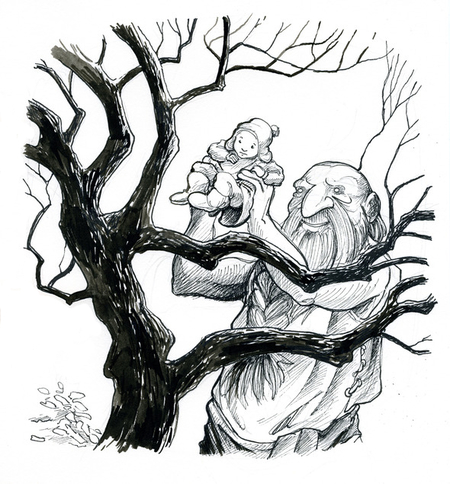
Only the little boy did not run, for his eyes were so full of tears that he did not see the Giant coming. And the Giant stole up behind him and took him gently in his hand, and put him up into the tree. And the tree broke at once into blossom, and the birds came and sang on it, and the little boy stretched out his two arms and flung them round the Giant’s neck, and kissed him. And the other children, when they saw that the Giant was not wicked any longer, came running back, and with them came the Spring. “It is your garden now, little children,” said the Giant, and he took a great axe and knocked down the wall. And when the people were going to market at twelve o’clock they found the Giant playing with the children in the most beautiful garden they had ever seen.
All day long they played, and in the evening they came to the Giant to bid him good-bye.
“But where is your little companion?” he said: “the boy I put into the tree.” The Giant loved him the best because he had kissed him.
“We don’t know,” answered the children; “he has gone away.”
“You must tell him to be sure and come here to-morrow,” said the Giant. But the children said that they did not know where he lived, and had never seen him before; and the Giant felt very sad.
Every afternoon, when school was over, the children came and played with the Giant. But the little boy whom the Giant loved was never seen again. The Giant was very kind to all the children, yet he longed for his first little friend, and often spoke of him. “How I would like to see him!” he used to say.
Years went over, and the Giant grew very old and feeble. He could not play about any more, so he sat in a huge armchair, and watched the children at their games, and admired his garden. “I have many beautiful flowers,” he said; “but the children are the most beautiful flowers of all.”
One winter morning he looked out of his window as he was dressing. He did not hate the Winter now, for he knew that it was merely the Spring asleep, and that the flowers were resting.
Suddenly he rubbed his eyes in wonder, and looked and looked. It certainly was a marvellous sight. In the farthest corner of the garden was a tree quite covered with lovely white blossoms. Its branches were all golden, and silver fruit hung down from them, and underneath it stood the little boy he had loved.
Downstairs ran the Giant in great joy, and out into the garden. He hastened across the grass, and came near to the child. And when he came quite close his face grew red with anger, and he said, “Who hath dared to wound thee?” For on the palms of the child’s hands were the prints of two nails, and the prints of two nails were on the little feet.
“Who hath dared to wound thee?” cried the Giant; “tell me, that I may take my big sword and slay him.”
“Nay!” answered the child; “but these are the wounds of Love.”
“Who art thou?” said the Giant, and a strange awe fell on him, and he knelt before the little child.
And the child smiled on the Giant, and said to him, “You let me play once in your garden, to-day you shall come with me to my garden, which is Paradise.”
And when the children ran in that afternoon, they found the Giant lying dead under the tree, all covered with white blossoms.
From The Happy Prince, and Other Tales, by Oscar Wilde.
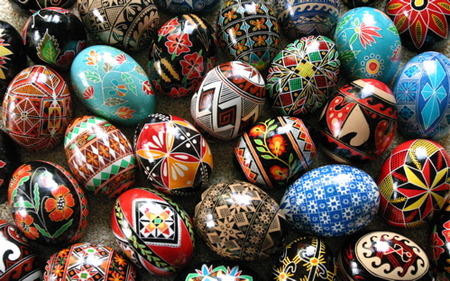
CC-BY-SA by Lube PetrushaHave you ever seen such amazing Easter eggs? It’s hard to believe they’re really eggs. But they are. People paint these extraordinary designs on ordinary, fragile eggs. They’ve been doing it for hundreds of years.
How to Write an Egg
Actually, they don’t exactly “paint” them. They “write” them. That’s why these eggs are called pysanky, from the word pysaty, which means to write. (You pronounce pysanky as “PIH-sahn-kih”, not “pie-SAHN-kee”.)
How do you write on an egg? You use a special tool called a stylus. This kind of stylus, called a kystka, looks a little like a pen, but instead of ink, it writes with hot wax!
These special tools write on an eggshell using hot wax. CC-BY-SA by Lube Petrusha
Have you ever written on an Easter egg with a crayon, then dipped the egg in the dye? The dye colors the whole egg except where you wrote. This is the same basic idea.
So how can these eggs look so beautiful? First, the tip of the stylus is much more precise than a crayon. With practice, you can write designs in fine detail.
Second, each pysanka is dyed in several colors, not just one. Each “layer” of colors has its own designs. First you write on the plain white egg. If you dye the egg yellow, you’ll have a yellow egg with white designs.
Then you can write new designs on the yellow egg. Then dye the egg orange. Now you’ll have an orange egg with both yellow designs and the white designs you drew first! You can keep adding designs and colors, from lightest to darkest, until the entire egg is covered with wax.
Last of all, you hold the egg next to (never above!) a lit candle. The wax melts away, revealing your beautiful pysanka.
Pysanky, Pisanki, Pisanice…
Many people in Eastern Europe use this “wax-resist” method to decorate Easter eggs. But the word pysanky comes from the country of Ukraine. Ukranians are famous for their fabulous eggs. But their neighbors in other Slavic countries decorate their eggs as well.
In Poland, they call their decorated eggs pisanki. In Croatia, they’re pisanice. Like pysanky, these names also come from words meaning, “to write”.
And there are other decorating techniques, too. You can paint with colored wax, or use make designs using onions, or leaves, or even straw!
These eggs from Czech Republic are decorated with colored wax. Public domain by Cheva.
The Meaning of the Eggs
Everything on each pysanka has a meaning, both the “motifs” (symbols and designs) and the colors. Some symbols are obvious, like the cross. Others might be hard to guess. Curls can mean “protection”, but a symbol for the “protection of young” is a the foot of a hen. Diamonds can mean “knowledge”. But a triangle with a dot represents the eye of God.
Of course, you can’t read an egg like a book. Each color and many symbols have several possible meanings. And different meanings in different villages. Besides, there are several thousand folk motifs for pysanky!
But whatever else they mean, most pysanky also celebrate the same thing: that Jesus rose from the dead. An egg looks like a dead rock. But then a new, living chick suddenly breaks out. Every new hatching can remind us of when Jesus broke out of the rocky tomb.

![[Plastic Eggs]](https://upload.wikimedia.org/wikipedia/commons/5/50/Easter_Eggs_Plastic_Colors.jpg)
![[Ordinary Dyed Eggs]](https://upload.wikimedia.org/wikipedia/commons/c/c2/Easter_Eggs_by_Mystaric_on_Flickr.png)
![[Pysanky]](https://upload.wikimedia.org/wikipedia/commons/5/5b/UkiePysanky2006.jpg)
![[Styli]](https://upload.wikimedia.org/wikipedia/commons/f/f2/UkieStyluses.jpg)
![[Eggs decorated with colored wax]](https://upload.wikimedia.org/wikipedia/commons/c/cb/Velikono%C4%8Dn%C3%AD_vaj%C3%AD%C4%8Dka_malovan%C3%A1_voskem.jpg)
![[More Pysanky]](https://upload.wikimedia.org/wikipedia/commons/8/81/VolynPysanky.jpg)
 A Catholic magazine for kids!


